D&D rules explained
Opportunity attacks in D&D 5e.
An opportunity attack is a free melee attack you make with your reaction when a creature you can see moves out of your reach. It happens right before the creature leaves your reach. You can avoid provoking one by taking the Disengage action, and moving while staying inside the creature’s reach never provokes one.
What triggers an opportunity attack
The trigger is leaving a creature’s reach. Reach is 5 feet for most creatures, and longer for a few, such as a monster with a 10-foot polearm attack.
5E (2014): a hostile creature that you can see moves out of your reach.
5.5E (2024): a creature that you can see leaves your reach without taking the Disengage action or teleporting.
What you do when it triggers
You spend your reaction to make one melee attack against the creature. The attack happens right before it leaves your reach, so a hit can still stop it from getting away with the free movement it planned. In 5.5E the attack can be with a weapon or an Unarmed Strike.
You have one reaction per round, so you can normally make only one opportunity attack between the start of your turn and the start of your next.
What does not provoke one
- Disengage. Taking the Disengage action means your movement does not provoke opportunity attacks for the rest of the turn.
- Moving inside the reach. Walking around a creature without leaving its reach never provokes.
- Teleporting.
- Being moved without using your own movement, action or reaction, such as being pushed or pulled by a spell or an ally.
A creature that cannot take reactions, such as one that is stunned, paralyzed, unconscious or incapacitated, cannot make an opportunity attack at all.
An example
A goblin stands 5 feet from a fighter, and the fighter has not used his reaction this round.
The goblin runs 30 feet away without taking Disengage. The fighter spends his reaction on a melee attack as the goblin leaves his reach.
If the goblin had taken Disengage as its action first, it could run the same 30 feet and the fighter would get no attack.
How Warfront handles it
Opportunity attacks are on by default, with a house-rules switch if your table plays without them.
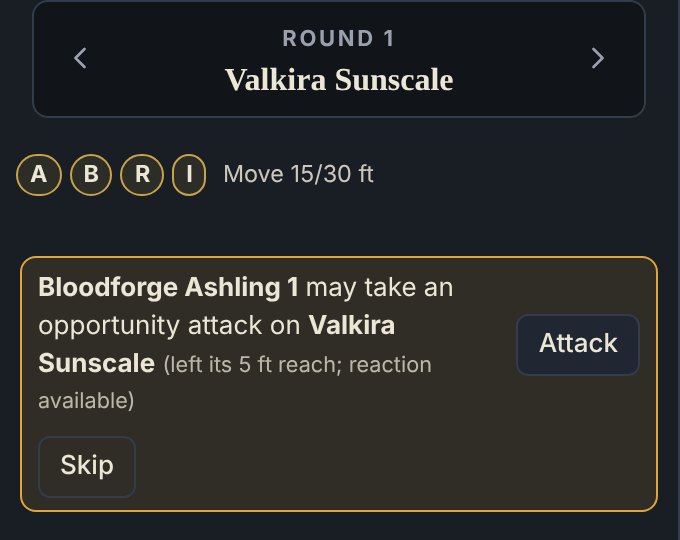
- When a creature walks out of an enemy’s reach on the map, Warfront works out who could take an opportunity attack and the Game Master gets a prompt.
- It uses each creature’s real reach (5 feet unless its attack says more), its size, and whether it still has a reaction. Creatures that cannot react are left out, and nothing is offered after a Disengage.
- Nothing is rolled or applied by itself. The Game Master decides whether the attack is made, and an attack that is made goes through the normal attack card, with its reason and an Undo.
Questions
Does an opportunity attack use my action?
No. It uses your reaction, so it does not take away your action, bonus action or movement on your own turn.
Can I make more than one opportunity attack in a round?
Normally no, because you get one reaction per round and an opportunity attack spends it. A few features grant extra reactions.
Does a ranged attacker provoke when walking away?
Yes. Provoking depends on leaving a creature’s reach, not on how you attack. The opportunity attack itself has to be a melee attack.
Does moving from one square to another inside reach provoke?
No. Only leaving the reach provokes an opportunity attack.
Do I provoke if an ally pushes me away?
No. Movement that does not use your own movement, action or reaction does not provoke.
See the rules run
A ready-made fight in your browser. No account. About a minute.