D&D rules explained
How combat works in D&D 5e, step by step.
Combat is played in rounds of about six seconds. Everyone rolls initiative once, then takes turns in that order. On your turn you can move and take one action, plus a bonus action if something gives you one. You also get one reaction per round, which you can spend on anyone’s turn. The rounds repeat until one side is beaten, flees or surrenders.
Step 1: Check for surprise
Before the first turn, the Game Master decides whether anyone is surprised, usually because they did not notice the other side.
5E (2014): a surprised creature cannot move or take an action on its first turn, and it cannot use a reaction until that turn ends.
5.5E (2024): being surprised no longer skips a turn. A surprised creature has disadvantage on its initiative roll instead.
Step 2: Roll initiative
Each creature rolls a d20 and adds its Dexterity modifier. The highest total goes first and the order runs down from there. The Game Master rolls for the monsters, and often makes one roll for a group of identical ones.
If two creatures tie, the Game Master decides the order among tied monsters, the players decide among tied heroes, and the Game Master breaks a tie between a hero and a monster. The order stays the same for the whole fight.
You can track it on paper, or use the free initiative tracker.
Step 3: Take your turn
On your turn you can do all of these, in any order:
- Move up to your speed. You can split the movement, for example move, attack, then move again. Difficult terrain costs extra, and standing up from prone costs half your movement.
- Take one action. Attack, Cast a Spell, Dash, Disengage, Dodge, Help, Hide, Ready, Search or Use an Object. Class features add more.
- Take one bonus action, only if you have one. A class feature or spell has to give it to you, and you get at most one per turn.
- Interact with one object for free, such as drawing a weapon or opening a door.
In 5.5E some actions are renamed or added: Cast a Spell is called Magic, Use an Object is Utilize, and Influence and Study are new. The turn itself works the same way.
Step 4: Make attacks
To attack, roll a d20 and add your ability modifier and your proficiency bonus if you are proficient with the weapon or spell. If the total meets or beats the target’s Armor Class (AC), you hit and roll damage.
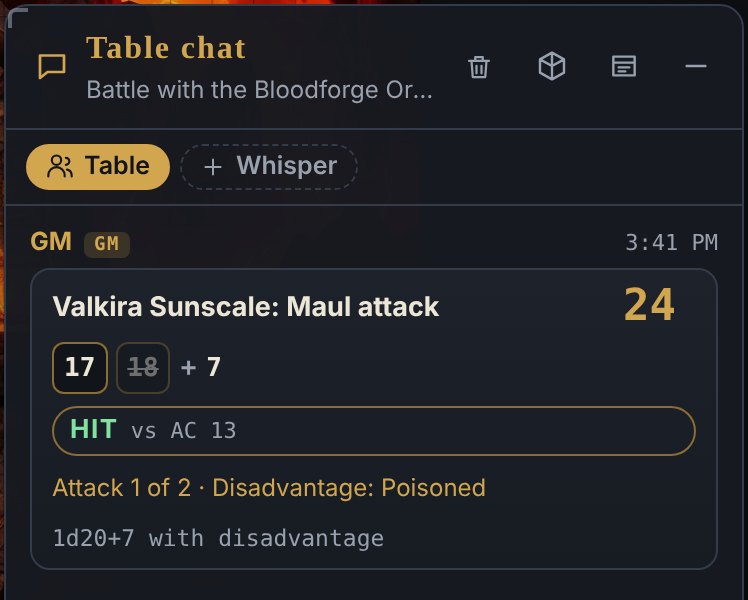
A natural 20 is a critical hit, which doubles the damage dice. A natural 1 always misses. Advantage means rolling two d20s and taking the higher one, and disadvantage means taking the lower one. Half cover adds 2 to the target’s AC, and three-quarters cover adds 5.
Step 5: Spend your reaction when it fits
You get one reaction per round, and it comes back at the start of your next turn. You can use it on anyone’s turn, not only your own. The usual uses are an opportunity attack, a spell such as Shield, and a Readied action when its trigger happens.
Step 6: Damage, zero hit points and death saves
Damage takes away hit points. A hero who drops to 0 falls unconscious and starts making death saving throws at the start of each of their turns: roll a d20, and 10 or higher is a success. Three successes make them stable, and three failures kill them. A natural 20 brings them back with 1 hit point, and a natural 1 counts as two failures. Taking damage at 0 hit points is a failure too.
If one hit leaves the leftover damage equal to or greater than the hero’s hit point maximum, they die at once. Most monsters simply die at 0, though that is the Game Master’s call.
Step 7: End the round and go again
When the last creature has acted, the round ends and the order starts over from the top. Combat ends when one side is defeated, flees or surrenders, or when the story moves on.
A round, in short
Round 1. Thorin (initiative 17) moves 20 feet, attacks the goblin with his axe, and rolls a 14 plus 5 for 19 against AC 15: a hit.
He rolls damage and the goblin drops. Thorin ends his turn with his reaction still unspent.
The goblin boss (initiative 12) goes next. When Thorin’s friend runs past it, the boss uses its reaction for an opportunity attack.
How Warfront runs combat
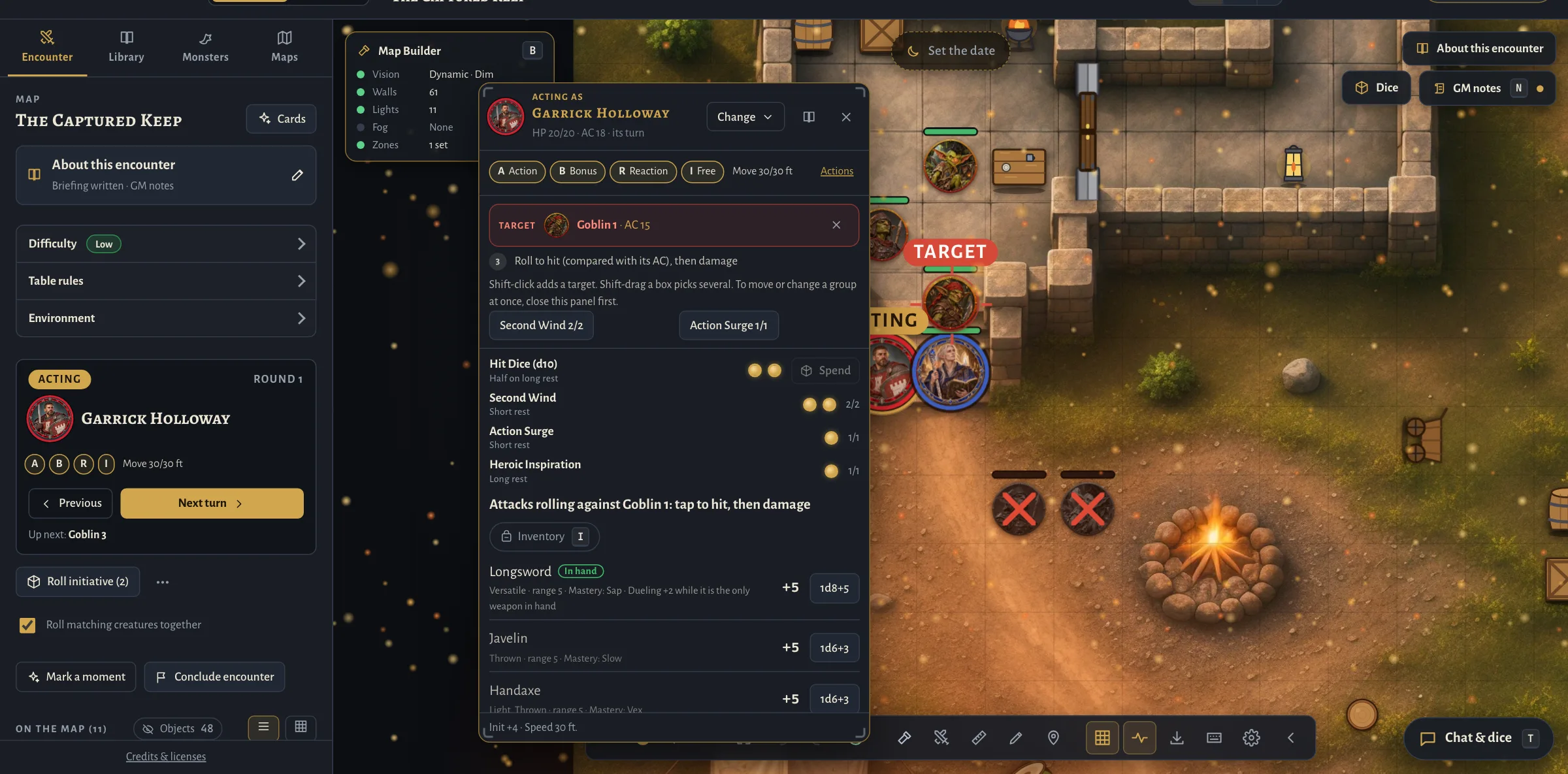
Warfront keeps the order and the bookkeeping, and you keep the decisions. You roll the dice, in the app or at the table, and Warfront works out what the roll means.
- Initiative order is tracked on screen, with the current turn highlighted and a Next turn button.
- Each creature’s action, bonus action, reaction and movement are tracked on its turn.
- Pick a target and roll to hit: Warfront compares the total with the target’s AC, applies advantage, disadvantage and cover, and shows the reason on the card.
- Damage is applied with resistances, vulnerabilities and immunities, and death saves run when a hero drops to 0.
- Monster turns, including Multiattack and legendary actions, run in one press.
- Every automatic result has an Undo, and anything that changes another creature goes to the Game Master to confirm. Every rule has its own switch in Combat helpers.
Which rules a table uses, 2014 or 2024, is chosen per table.
Questions
How long is a round in D&D 5e?
A round is about six seconds of game time. Everyone in the fight takes one turn per round, so a long fight is many rounds.
Can I move, attack and then move again?
Yes. You can split your movement before and after your action, as long as the total stays within your speed.
Does everyone get a bonus action?
No. You only have a bonus action if a class feature, spell or other ability gives you one, and you can use only one per turn.
Can I use my reaction on my own turn?
Only if its trigger happens, and most triggers come from other creatures’ actions. Your reaction refreshes at the start of your turn, so you have it available again as soon as your turn begins.
What changed in the 2024 rules?
Surprise now gives disadvantage on initiative instead of skipping a turn, and some actions were renamed or added. The turn structure, attack rolls and death saves work the same way.
Keep reading
Opportunity attacks in 5e
When leaving a creature’s reach costs you a free hit, and how to avoid it.
Initiative tracker
A free tracker for turn order, with no sign-up.
Combat automation
How Warfront works out attacks, saves, spells and monster turns.
Encounter calculator
Check how hard a fight will be before you run it.
See the rules run
A ready-made fight in your browser. No account. About a minute.